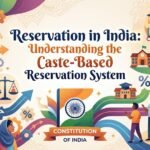






India’s reservation system is one of the world’s largest and most debated affirmative action policies. Designed to correct centuries of social exclusion based on caste, it reserves seats in education, government jobs, and legislatures for historically marginalized communities. This blog explains what it is, why it exists, how it works, its achievements, criticisms, and ongoing debates — in plain language.
What Is Reservation?
Reservation (also called the quota system) sets aside a fixed percentage of seats or posts for specific groups so they can access opportunities that were long denied to them. It is not a poverty-alleviation scheme alone. Its primary goal is representation and social justice — ensuring that communities blocked from education, administration, and power for generations get a fair chance to participate.
The main beneficiary groups are:
- Scheduled Castes (SCs) — communities that historically faced untouchability (often called Dalits)
- Scheduled Tribes (STs) — indigenous tribal communities
- Other Backward Classes (OBCs) — socially and educationally backward castes identified by commissions
- Economically Weaker Sections (EWS) — added later for poorer people from the general (unreserved) category
A Brief History
The roots go back before independence. Social reformers like Jyotirao Phule highlighted caste exclusion. In 1902, the ruler of Kolhapur introduced early reservations. The British-era Communal Award (1932) and the Poona Pact between Mahatma Gandhi and Dr. B.R. Ambedkar created reserved seats for Dalits.
After independence, the Constitution of India (1950) gave the system legal foundation. Initially focused on SCs and STs, it expanded when the Mandal Commission (1979–80) recommended 27% reservation for OBCs. Implementation in 1990 by the V.P. Singh government triggered massive protests but permanently changed Indian politics by empowering OBC communities.
Constitutional Foundation
The system rests on these key articles:
- Articles 15(4) and 16(4) allow special provisions for backward classes in education and public jobs.
- Later amendments added reservation in promotions for SCs/STs, extended it to private educational institutions, and created the 10% EWS quota (103rd Amendment, 2019).
- Seats are also reserved for SCs and STs in Parliament, state assemblies, and local bodies.
The Supreme Court has shaped the rules. The landmark Indra Sawhney judgment (1992) upheld OBC reservation, set a general 50% ceiling on total caste-based quotas, introduced the “creamy layer” concept (excluding better-off individuals within OBCs), and clarified that caste can be used to identify backwardness but is not the only factor.
Current Quotas (Central Level)
Here is the typical breakdown used in central government jobs and many educational institutions:
| Category | Reservation % |
|---|---|
| Scheduled Castes (SC) | 15% |
| Scheduled Tribes (ST) | 7.5% |
| Other Backward Classes (OBC) | 27% |
| Economically Weaker Sections (EWS) | 10% |
| Total | ≈ 59.5% |
A further 4% horizontal reservation exists for persons with disabilities. State percentages can differ based on local population. The “creamy layer” income limit for OBCs is currently around ₹8 lakh family income per year (with additional criteria).
Why Does India Have This System?
Caste was not just a social ranking — it determined who could study, own land, enter temples, or hold office. SCs and STs faced deep exclusion for centuries. Reservation aims to break that cycle by guaranteeing access and representation so these communities can build capability and influence over time.
Data shows clear progress: far more SC, ST, and OBC students now enter higher education and government service than before. Political representation has also improved dramatically in many states.
Achievements and Limitations
Positive outcomes include greater diversity in universities, civil services, and legislatures, and the creation of a growing middle class within reserved communities.
Challenges remain:
- Many reserved posts stay vacant because of a shortage of eligible candidates or other barriers.
- Benefits are sometimes captured by better-off subgroups within the reserved categories (the “creamy layer” problem).
- Public-sector jobs are shrinking, limiting the system’s reach.
- Private-sector representation of SCs and STs remains low.
- Intense competition for the remaining open seats creates resentment among general-category candidates.
Key Debates Today
- Merit vs Justice — Critics say quotas lower standards. Supporters reply that “merit” itself is shaped by prior social advantages and that representation is a form of justice.
- Creamy Layer for SCs/STs — Currently applied mainly to OBCs. Courts have discussed extending it; governments have largely resisted.
- Sub-classification — The Supreme Court (2024) allowed states to create sub-quotas within SCs so the most backward groups get priority.
- 50% Ceiling — The EWS quota pushed the total above 50%. Some states already exceed it. Future caste census data may increase pressure for revision.
- Caste Census — India has not conducted a full caste count since 1931. Recent state surveys and plans for a national one could reshape quotas based on actual population shares.
Looking Ahead
Reservation is not static. Recent developments include women’s reservation in legislatures (to take effect after the next delimitation), ongoing court cases on state-specific quotas (like Maratha or others), and debates on whether the system should eventually shift more toward economic criteria or become time-bound.
The policy continues because large gaps in education, jobs, assets, and social status still exist along caste lines. At the same time, questions about efficiency, fairness to all citizens, and long-term goals of a more equal society remain live.
Final Takeaway
India’s reservation system is a constitutional response to a unique historical reality — deep, hereditary social exclusion. It has opened doors for millions while generating sharp debates about equality, merit, and identity. Understanding both its purpose and its imperfections helps us discuss it more honestly.
Whether one supports expanding it, reforming it, or gradually reducing reliance on it, the conversation must start with facts rather than slogans. The system exists because caste still shapes opportunity in India. How long it should continue, and in what form, is a question Indian society continues to answer through politics, courts, and public debate.
Read more blogs : Assam’s 2026 Floods: When the Rivers Rose Faster Than the Warnings