
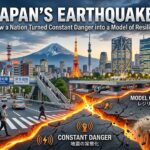


Japan experiences more felt earthquakes than almost any other country on Earth. Roughly 1,500 tremors are registered every year, and the islands sit directly on the Pacific Ring of Fire where four tectonic plates collide. This geological reality has produced some of the deadliest natural disasters in modern history. Yet Japan has also become the global benchmark for earthquake survival. Through rigorous engineering, real-time technology, strict building codes, and a deeply rooted culture of preparedness, the country has dramatically reduced the human cost of even powerful quakes.
This article explores why Japan shakes so often, the major disasters that shaped its approach, the concrete technologies and policies that keep buildings standing and people alive, and the challenges that remain.
Why Japan Experiences So Many Earthquakes
Japan lies at the junction of the Pacific, Philippine Sea, Eurasian, and North American plates. The Pacific Plate subducts beneath the others along deep ocean trenches east and south of the main islands. This process generates two primary types of earthquakes:
- Megathrust events along the plate boundaries, which can reach magnitude 8 or 9 and often trigger tsunamis.
- Shallow crustal earthquakes on inland faults, which produce intense local shaking even at moderate magnitudes.
Historical records dating back more than 1,400 years document repeated large events. The 869 Jōgan earthquake and tsunami, for example, inundated the Sendai plain in a pattern strikingly similar to the 2011 disaster. Modern monitoring confirms that major events along the Nankai Trough or Japan Trench occur on multi-century cycles, while smaller quakes happen almost daily. Recent strong shocks, including the magnitude 7.6 Noto Peninsula earthquake on New Year’s Day 2024, show that the threat remains constant.
Lessons Written in Destruction: Key Historical Earthquakes
Each major disaster forced Japan to rewrite its rules.
The Great Kantō Earthquake of 1923 (magnitude approximately 7.9–8.2) killed more than 105,000 people, largely through firestorms that consumed Tokyo and Yokohama. The catastrophe led to the first formal seismic provisions in building regulations and sparked a national conversation about urban planning and fire prevention.
The Great Hanshin (Kobe) Earthquake of 1995 (magnitude 7.3) claimed over 6,400 lives. Nearly all of the collapsed buildings had been constructed before the 1981 code update. This event accelerated retrofitting programs, improved emergency coordination, and highlighted the vulnerability of older wooden housing and elevated highways.
The Great East Japan Earthquake and Tsunami of 2011 (magnitude 9.0–9.1) remains the most powerful quake ever recorded in Japan. The resulting tsunami waves reached heights of over 40 meters in places and caused nearly 20,000 deaths or missing persons. It also triggered the Fukushima nuclear accident. The disaster prompted major upgrades to tsunami defenses, early-warning systems, and nuclear safety standards.
These events created a clear pattern: Japan does not simply rebuild after each tragedy. It systematically studies failures and embeds the lessons into law, engineering practice, and daily life.
Engineering Resilience: Three Core Strategies
Japanese earthquake engineering rests on three complementary approaches, often described with the terms taishin, seishin, and menshin.
Strengthening Structures (Taishin)
The foundational strategy is to make buildings strong and ductile enough to survive intense shaking without collapsing. After 1923, seismic rules entered the Building Standard Law. The decisive change came with the 1981 New Earthquake Resistant Building Standards Amendment. It required that buildings suffer only minor damage in events around magnitude 7 and simply refuse to collapse in stronger shaking. Later revisions after Kobe and subsequent quakes raised design forces, improved detailing of concrete columns and steel connections, and introduced performance-based design.
In practice this means thicker reinforced-concrete walls, steel moment frames that can flex without brittle failure, and careful attention to foundations. Government programs actively push for the seismic retrofitting of older homes, especially wooden houses built before 1981. Targets include making almost all residences earthquake-resistant and installing quake-sensitive circuit breakers that automatically cut power to reduce fire risk.
Absorbing Energy (Seishin)
Rather than fighting the motion with pure stiffness, many modern buildings incorporate devices that dissipate seismic energy. Hydraulic oil dampers, steel yielding dampers, and viscoelastic materials convert kinetic energy into heat. Tuned mass dampers—large weights suspended high in a building—swing opposite to the structure’s motion and reduce sway. Tokyo Skytree and numerous high-rises combine these systems so that even in strong shaking the interior remains relatively stable.
Isolating Buildings from the Ground (Menshin)
The most advanced approach completely decouples a structure from ground motion. Buildings rest on laminated rubber bearings (often containing a lead core for damping), friction pendulum bearings, or sliding systems. When the ground moves, the isolation layer absorbs the displacement and the superstructure experiences far lower accelerations. More than 9,000 buildings in Japan now use base isolation—among the highest rates in the world. Hospitals, government offices, data centers, and high-value commercial towers prioritize this technology. Experimental active systems go further, using computer-controlled actuators to push the building in the opposite direction of the detected motion, reducing shaking to a small fraction of the ground motion.
Traditional Japanese wooden architecture already embodied a form of flexibility through interlocking joints that allowed limited movement. Modern practice has refined and scaled these principles with advanced materials and precise engineering.
The Power of Seconds: Earthquake Early Warning
Technology gives people and systems critical time to act. The Japan Meteorological Agency operates a nationwide Earthquake Early Warning (EEW) network that has been live for the public since 2007. Thousands of seismometers on land and on the seafloor—detect the faster primary (P) waves. Computers instantly estimate magnitude, location, and expected intensity, then issue warnings before the slower, more destructive secondary (S) waves arrive.
Warnings reach television, radio, smartphones, and the national J-Alert system within seconds. Lead times of several to tens of seconds allow trains to brake, elevators to stop at the nearest floor, factories to shut down hazardous processes, and individuals to take cover. The system triggers for predicted Japanese seismic intensity of lower 5 or higher. Continuous improvements after 2011, including better algorithms for large complex ruptures and denser ocean-bottom sensors, have increased accuracy and reduced false alarms.
Preparedness Beyond Buildings: Culture, Education, and Policy
Physical resilience is only half the story. Japan maintains a strong culture of readiness. Schools conduct regular earthquake and tsunami drills. Households are encouraged to keep emergency kits with water, food, radios, and first-aid supplies. Local governments stock evacuation centers—often school gymnasiums—and use clear color-coded warning levels so residents know exactly when to prepare or leave.
Policy keeps evolving. After major events, laws are revised and budgets allocated for prevention. Recent national plans aim to cut projected deaths from a major Tokyo-area earthquake by half or more within a decade through fire prevention, nearly universal residential retrofitting, and improved continuity of government operations. Investments running into trillions of yen target aging infrastructure, digital systems for tracking disaster victims, and private-sector innovation in AI-based damage assessment and evacuation support. A new centralized Disaster Management Agency is scheduled to launch to shift emphasis further from reactive response toward long-term preparedness.
Remaining Challenges and the Path Forward
Despite remarkable progress, vulnerabilities persist. Older wooden housing stock in some rural and dense urban areas still performs poorly. Soft soils can amplify shaking and cause liquefaction. Cascading hazards—tsunamis, fires, and landslides continue to cause most fatalities in the largest events. Long-period ground motion can challenge very tall buildings. An aging population complicates rapid evacuation. And while modern codes prevent collapse, non-structural damage and economic disruption remain significant.
Japan’s response is continuous improvement rather than complacency. Each new quake feeds data into research facilities such as the massive E-Defense shake table, updates to codes, and public education campaigns. The country is investing heavily in the coming years to harden lifeline infrastructure and expand the use of emerging technologies.
Conclusion: A Model Built on Realism and Discipline
Japan cannot eliminate earthquakes. What it has done is refuse to treat them as inevitable mass-casualty events. Through a century of hard lessons, the nation has built a multi-layered system: strong and flexible buildings, real-time warnings measured in seconds, a public trained to respond, and institutions that learn and adapt after every major shock.
The results speak clearly. Newer buildings overwhelmingly survive strong shaking. Fatality rates in recent large earthquakes have been far lower than in comparable events of earlier decades. Japan’s experience demonstrates that sustained investment, rigorous standards, technological innovation, and a culture that treats preparedness as ordinary can turn one of the planet’s most dangerous geological settings into a place where life continues with remarkable resilience.
Read other blog : Assam’s 2026 Floods: When the Rivers Rose Faster Than the Warnings

